What Your Hands Already Know: Using Tactile Clues to Forecast How a Fabric Will Age
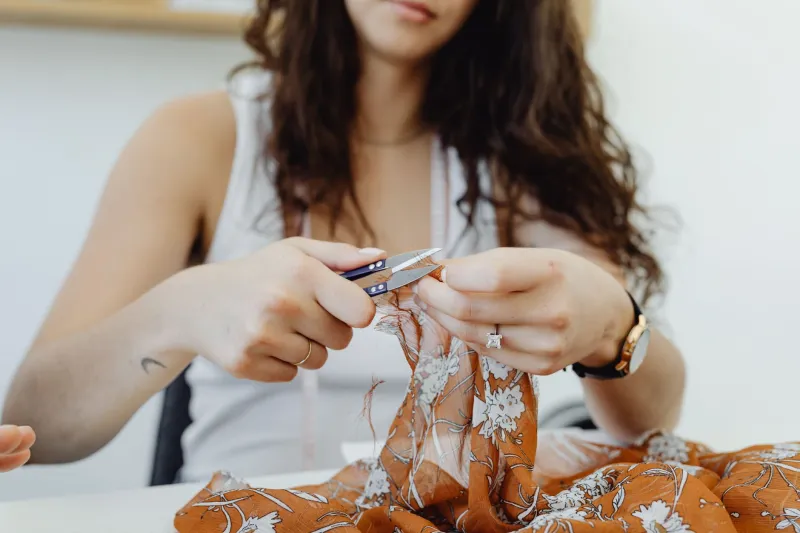
There is a moment in every designer's process—often unremarked upon and rarely formalized—when a bolt of fabric is lifted from the table, squeezed lightly in one fist, and then released. What happens next is not simply aesthetic intuition. It is, in fact, a rudimentary materials test, one that encodes information about fiber quality, finishing chemistry, and the structural integrity of the weave or knit. The challenge is that most practitioners have never been taught to read that information systematically.
This guide offers a framework for doing exactly that: transforming an instinctive gesture into a reproducible diagnostic protocol that predicts long-term garment behavior before construction begins.
The Mechanics of Crush Recovery
Crush recovery—the speed and completeness with which a fabric rebounds after compression—is among the most informative tactile signals available at the point of handling. To conduct a basic crush test, gather a section of fabric in your palm, apply firm but not forceful pressure for approximately ten seconds, then release and observe.
A fabric that springs back immediately and fully suggests high elastic recovery in its fibers. Wool, for instance, owes much of its legendary resilience to the crimped, coiled architecture of its protein chains, which function similarly to a mechanical spring. Polyester microfibers exhibit comparable recovery for different reasons: their synthetic polymer structure resists permanent deformation under moderate stress. By contrast, a fabric that retains the creased geometry of your grip—slowly relaxing over thirty seconds or more, or failing to recover entirely—signals fibers with low resilience, often exacerbated by poor twist balance in the constituent yarns.
The practical implication is direct: a fabric with poor crush recovery will wrinkle aggressively in wear. Elbows, seat areas, and any point of repeated flexion will develop set creases that laundering may not fully remove. For a structured blazer or tailored trouser, this is a fundamental performance failure. For a deliberately casual linen shirt, it may be entirely acceptable—but the designer should enter that choice with full awareness, not discover it after the garment ships.
Surface Friction as a Fiber Quality Indicator
Run your fingertips slowly across the face of a fabric, then across its reverse. The frictional resistance you feel—or conspicuously do not feel—communicates information about fiber length, surface finish, and the likelihood of pilling.
Short-staple fibers, regardless of whether they are cotton, wool, or a natural-synthetic blend, produce fabrics with a slightly rough, almost grabby surface texture. Under magnification, this roughness corresponds to fiber ends protruding from the yarn structure. In wear, these same protruding ends are what tangle together to form pills. A fabric that catches your fingernail almost imperceptibly as you stroke it is telling you that pilling risk is elevated—particularly in areas of abrasion such as underarms, inner thighs, and cuffs.
Long-staple and combed fibers, by contrast, produce a noticeably smoother surface. Pima and Egyptian cotton, worsted-spun wool, and high-tenacity polyester all share this characteristic. The smoothness is not merely cosmetic; it reflects a fiber-to-fiber alignment that resists the mechanical entanglement responsible for pilling. When sourcing fabrics for garments intended to withstand frequent use and laundering—workwear, activewear, or everyday separates—this surface friction test offers a faster preliminary screen than any label specification.
Decoding the Drape Drop
Hold a generous section of fabric at one corner and allow it to fall freely from your hand. Watch not just where it settles, but how it moves during the fall. Does it cascade in fluid, overlapping waves? Does it hold a stiff angular shape? Does it collapse into tight, irregular folds?
This informal drape drop reveals the relationship between a fabric's weight, its bending rigidity, and the degree to which any applied finish is dominating its natural fiber behavior. A fabric that drapes beautifully in-store but feels unusually stiff for its apparent weight is frequently one that has been treated with a resin or starch-based finish to improve its presentation on the bolt. These finishes are, in many cases, impermanent. After the first laundering, the fabric's true hand emerges—often far softer and more limp than the initial handling suggested. For a design that depends on structure or body, this post-wash transformation can be catastrophic.
The tell is a subtle one: a fabric that feels simultaneously crisp and light is worth scrutinizing. Natural stiffness in fabric is typically accompanied by weight or a dense weave structure. Stiffness without those correlates often signals a finish rather than an intrinsic property. Wetting a small corner of the fabric with water and allowing it to dry can confirm the suspicion; if the hand changes noticeably after the water evaporates, the finish is water-soluble and therefore wash-fugitive.
Resilience Under Repeated Stress
A single crush test provides a snapshot. A more informative protocol involves repeated compression in the same area—three to five cycles of squeezing and releasing at the same location on the fabric. Compare the recovery speed and completeness of the fifth cycle to the first.
Fabrics that recover equally well across all repetitions demonstrate genuine fiber resilience, the kind that will translate to a garment that retains its shape through years of wear. Fabrics that show progressively slower or less complete recovery are exhibiting fatigue behavior—a mechanical property that predicts premature deformation at stress points in the finished garment. Knees in trousers, elbows in jackets, and the seat of a dress are all areas of cyclical compression; a fabric that fatigues under five manual repetitions will almost certainly deform in those locations within a season of regular use.
This graduated test is particularly useful when evaluating blended fabrics, where the interaction between fiber types is not always predictable from the label. A polyester-rayon blend, for example, may show strong initial recovery—driven by the polyester component—but reveal progressive fatigue as the rayon's low resilience begins to dominate under repeated stress.
Translating Touch Into Specification Language
The practical value of these assessments extends beyond personal judgment. When communicating with mills, vendors, or production partners, the ability to articulate tactile findings in technical terms strengthens sourcing conversations considerably. Rather than describing a fabric as "not holding up well," a designer equipped with this framework can specify that crush recovery is incomplete after five cycles, that surface friction suggests short-staple fiber content, and that post-wet hand testing indicates a wash-fugitive finish—all of which are actionable observations a mill can respond to with specific alternatives or process modifications.
Fabric & Handle has addressed the challenge of translating hand-feel into mill language in prior coverage, but it bears repeating here: tactile fluency is only as useful as the vocabulary available to transmit it. Building that vocabulary begins with structured, deliberate handling—not the incidental squeeze of a bolt on a showroom floor, but a systematic sequence of assessments conducted with specific questions in mind.
The Discipline of Deliberate Handling
The most experienced textile professionals in the industry—pattern makers, production managers, master tailors—share a common habit: they handle fabric slowly and attentively before committing to a single technical decision. What distinguishes their practice from casual handling is not superior sensory ability but a disciplined interpretive framework.
The assessments described here require no laboratory equipment, no specialized instruments, and no investment beyond time and attention. They require only the willingness to treat the information a fabric offers under your hands as data rather than impression—to ask not merely whether a fabric feels good, but what that feeling is actually predicting about the garment it will eventually become.


