Material Resistance: Understanding Why Difficult Fabrics Behave the Way They Do—and How to Work With Their Physics
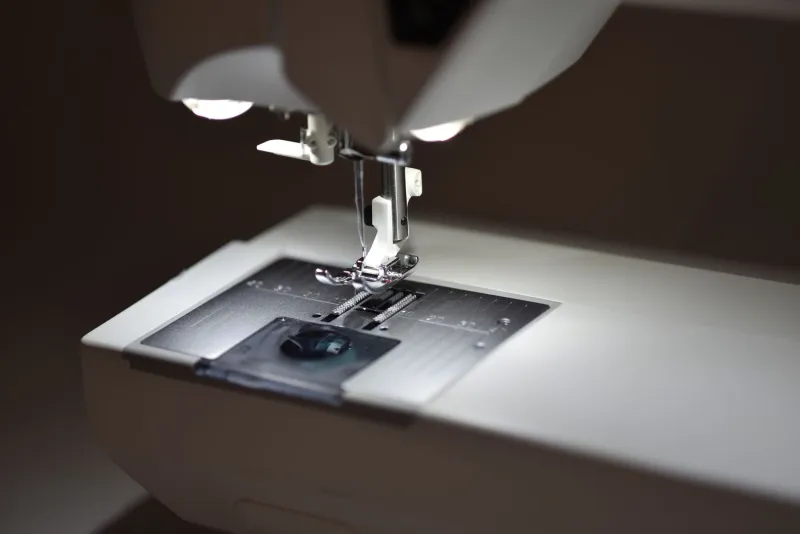
Every maker has a fabric that has defeated them. The charmeuse that shifts under the presser foot until the seam line bears no relationship to the chalk mark. The ponte knit that stretches unevenly through the feed dogs, producing a wavy hem that no amount of pressing will correct. The boiled wool that dulls needles, jams the machine, and refuses to ease around a sleeve cap with any grace. These are not failures of skill alone. They are failures of translation—moments when standard technique, designed for cooperative materials, meets a fabric with physical properties that make compliance impossible.
The productive response is not to find a workaround that forces the material into submission. It is to understand what the material is actually doing, and why, and to restructure the construction approach around those realities.
Slippery Weaves: The Physics of Low Surface Friction
Satin-weave fabrics—charmeuse, duchess satin, silk habotai, and their synthetic equivalents—present their primary construction challenge through surface friction, or rather its near-absence. The long floating yarns that produce the characteristic luster of a satin weave also minimize the contact area between the fabric surface and any tool that touches it. This includes the presser foot, the feed dogs, cutting table surfaces, and the layers of fabric stacked beneath the cutting line.
The consequence is that any lateral force—the forward motion of the presser foot, the pressure of a pin, the drag of a rotary cutter—causes the fabric to translate horizontally rather than remaining stationary. Two layers that were precisely aligned before sewing will have shifted by the time the seam is completed, producing the characteristic misalignment at notches and the gradual drift of the seam line away from its marked position.
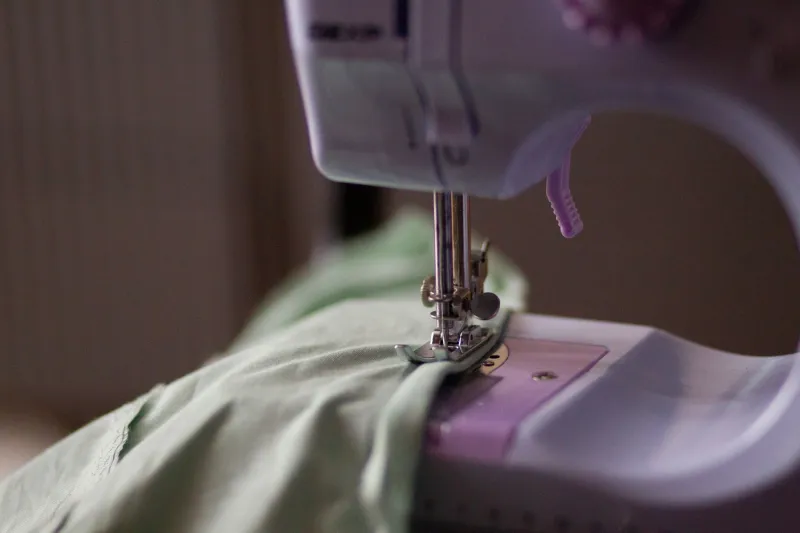
Addressing this requires increasing the effective friction at the points of contact rather than simply slowing down. A Teflon or roller presser foot reduces the drag between the foot and the fabric surface, which counterintuitively helps by making the foot's motion more consistent and less likely to create lateral displacement. Tissue paper or a stabilizer sheet placed between the fabric and the feed dogs adds grip without altering the fabric itself. Silk pins placed at right angles to the seam line—rather than parallel—minimize the displacement caused by each pin's insertion.
The most important adaptation, however, is reducing the seam length handled at one time. Rather than guiding a twenty-inch seam from beginning to end in a single continuous pass, breaking the seam into shorter sections with precise stopping and starting points maintains alignment more reliably than any presser foot substitution.
Knit Fabrics: Managing Extension Under Mechanical Stress
The challenge presented by knit fabrics is almost the inverse of the slippery weave problem. Where satins resist grip, knits extend under it. The loop structure of a knit construction—whether single jersey, interlock, or a structured ponte—allows the fabric to elongate in response to any tension applied perpendicular to the course direction. The feed dogs of a conventional sewing machine apply exactly this kind of tension as they advance the fabric, stretching the knit slightly with each stitch. The result is a seam that is shorter than the fabric sections it joins, causing the characteristic waviness that appears after the garment is removed from the machine.
A walking foot or a differential feed attachment addresses the mechanical source of this problem by advancing the upper and lower fabric layers simultaneously, eliminating the differential tension that causes extension. For lightweight jersey, a narrow zigzag stitch rather than a straight stitch accommodates the fabric's extension in the finished seam, preventing the thread from snapping under the lateral stress of wear.
The springback behavior of knit fabrics also affects cutting accuracy in ways that are less commonly discussed. A knit fabric spread on a cutting table is under slight tension simply from its own weight and the friction of the table surface. When pieces are cut and lifted, that tension releases and the pieces contract slightly—sometimes significantly in high-stretch constructions. Pattern pieces cut from knit fabrics should be allowed to relax on the table for several minutes before being moved to the machine, so that the relaxation occurs before the seam is sewn rather than after.
Stiff Wools and Heavy Wovens: The Compression and Recovery Problem
Boiled wool, heavy melton, and thick double-faced constructions present a different category of resistance: they are dense enough to compress under the presser foot, and their recovery from that compression is slow relative to the speed of the stitch cycle. The fabric that exits the machine is not the same thickness as the fabric that entered it; the compressed zone along the seam line remains flattened until heat and moisture restore its loft, which means the seam's mechanical behavior immediately after sewing is not representative of its behavior in the finished garment.
This has practical implications for seam allowance pressing and for ease distribution at curved seams. The ease that appears adequate when the fabric is compressed under the foot may prove insufficient once the fabric recovers its full loft, particularly at the sleeve cap, where a small deficit in ease translates directly into a pulled shoulder line.
Heavy wools also generate significant needle heat through friction, particularly when sewn at high speed. A needle that has been run through forty inches of boiled wool at full machine speed is meaningfully hotter than when it began, and that heat affects the thread passing through the eye, potentially weakening synthetic threads and causing them to snap under the tension of the final stitches in a long seam. Reducing machine speed and allowing periodic pauses in long seams addresses this without requiring any change to equipment.
Temperamental Blends: When Fiber Behaviors Conflict
Blended fabrics that combine fibers with significantly different physical properties—a polyester-rayon blend, a wool-silk suiting, a cotton-linen construction—present compound challenges because each fiber component responds differently to the same mechanical forces. A wool-silk blend, for example, combines wool's natural crimp and elasticity with silk's smooth surface and low friction. Under the needle, the two fiber types may advance at slightly different rates, producing a subtle but cumulative drift in the seam line over the length of a long seam.
The diagnostic approach for temperamental blends is to isolate which fiber's behavior is dominating the problem. If the fabric is shifting laterally, the silk component's low friction is likely the primary driver. If the seam is puckering, the wool component's elasticity and recovery is the more probable cause. Treating the fabric as a single material and applying a generic solution frequently addresses neither problem adequately.
Pressing behavior in blended fabrics requires the same fiber-by-fiber logic. A wool-polyester blend cannot be pressed at wool temperatures without risk to the polyester component, but pressing at polyester-safe temperatures may be insufficient to set the wool's memory. The correct approach is to press at the lower temperature with extended dwell time and a damp press cloth, relying on steam rather than heat to activate the wool fibers.
The Discipline of Material Observation
The common thread across all difficult fabrics is that their resistance is not arbitrary. Each problem has a physical cause that can be identified, and each cause has a corresponding adaptation that addresses it at the mechanical level rather than simply applying more force or more speed. The maker who understands why a charmeuse shifts, why a jersey stretches, and why a boiled wool compresses is equipped to construct a response that works with the material's properties rather than against them. That alignment between understanding and technique is, ultimately, what separates construction that holds from construction that merely appears to hold—until the first real stress reveals otherwise.