Point, Eye, and Scarf: The Mechanical Logic of Needle Compatibility Across Fabric Types
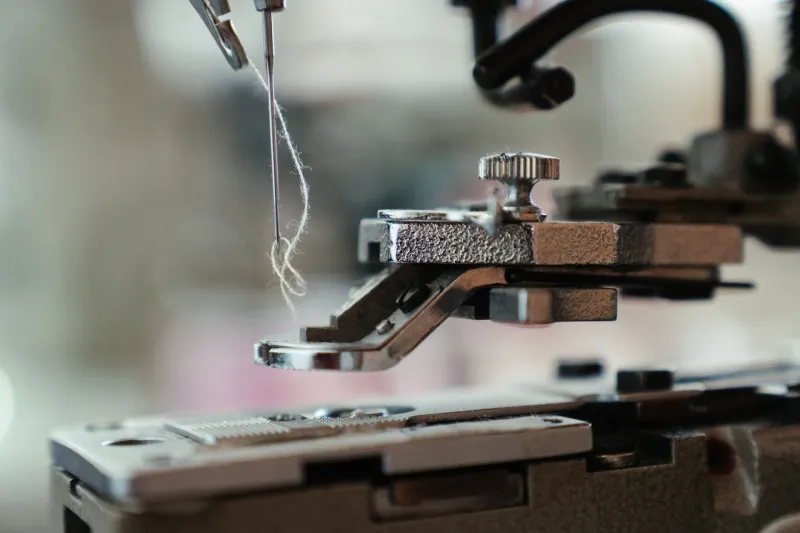
The needle is the first point of contact between machine and material, yet it receives a fraction of the analytical attention devoted to thread selection, seam allowances, or fabric preparation. Most practitioners consult a sizing chart, select a number that feels approximately correct for the weight in hand, and proceed. The results are often adequate. When they are not — when skipped stitches appear without explanation, when fabric puckers along an otherwise well-tensioned seam, or when a finished garment reveals a faint line of distorted fibers tracking the stitch path — the needle is rarely the first suspect.
It should be.
Needle geometry is not a secondary consideration. It is a set of interacting mechanical variables, each of which responds differently to specific fabric structures, fiber contents, and thread types. Treating those variables as a unified system rather than a checklist of isolated specs is what separates technically informed sewing from informed guesswork.
Diameter and Its Consequences
Needle diameter — expressed in both European metric sizing (60 through 120) and the corresponding American sizing system (8 through 19) — determines the size of the hole punched through the fabric with every stitch. That hole is not merely incidental. In woven fabrics, the needle must displace yarns to pass through the weave structure. In a tightly woven fabric such as a high-thread-count cotton shirting or a densely constructed wool suiting, an oversized needle forces yarns apart rather than passing cleanly between them. The resulting distortion can be permanent, particularly in fabrics with low elasticity and minimal yarn mobility.
In knits, the relationship is different but equally consequential. A needle that is too coarse relative to the loop structure can pierce rather than deflect individual yarns, cutting fibers that are load-bearing within the stitch. This is why ballpoint and jersey needles exist as a category: their rounded tip is designed to pass between rather than through the loops, preserving structural continuity.
The general principle is calibration, not minimization. Selecting the finest needle capable of accommodating the thread in use — without the thread binding in the eye or the needle flexing under resistance — is the operative standard.
The Scarf: An Underexamined Variable
The scarf is the indentation cut into the back of the needle shaft, positioned just above the eye. Its function is to create a window of clearance for the hook of the rotary mechanism to catch the thread loop and form a stitch. When the scarf depth is insufficient for the timing of a particular machine, or when the needle is inserted at the wrong orientation, the hook misses the loop and a skipped stitch results.
Scarf geometry also interacts with fabric thickness. In heavy materials — denim, canvas, multiple layers of interfaced suiting — the needle must travel further before the thread loop forms at the required position. Needles engineered for denim or heavy fabrics typically feature a more pronounced scarf to compensate for this displacement. Using a standard scarf needle in a heavy application does not merely risk skipped stitches; it introduces micro-level timing inconsistencies that can manifest as irregular stitch length even when machine settings remain unchanged.
For sewers working across a range of fabric weights within a single project — a structured jacket with unlined patch pockets, for instance — needle changes between construction stages are not optional. They are mechanically necessary.
Eye Size and Thread Behavior
The eye of the needle must accommodate the thread without either constricting it or allowing it to move loosely. Both failure modes produce seam problems, though they present differently.
A thread that fits too tightly through the eye generates friction with each stitch cycle. That friction produces heat, which in synthetic threads — particularly polyester — can cause localized melting at the needle point. The resulting thread is weakened at regular intervals corresponding to stitch length, creating a seam that appears sound but carries hidden structural vulnerabilities. In natural fibers, tight-eye friction produces abrasion and fiber breakage, visible as a frayed or weakened thread over time.
Conversely, a thread that is undersized relative to the eye moves inconsistently, producing variable loop formation and erratic tension. The seam may appear visually acceptable but will not perform uniformly under stress.
The practical implication is that needle selection and thread selection are not sequential decisions. They are simultaneous ones. The thread diameter dictates the minimum viable eye size; the fabric dictates the maximum viable shaft diameter. The needle specification that satisfies both constraints is the correct choice — not the one that satisfies either in isolation.
Needle Point Geometry and Weave Structure
Beyond the ballpoint-versus-sharp distinction lies a more granular taxonomy of needle points that most sewers never encounter. Universal points represent a compromise geometry intended to function across wovens and stable knits. Sharp or Microtex points are ground to a finer taper, designed for precise penetration in tightly woven fabrics such as microfibers, silk charmeuse, and high-density synthetic sheeting. Quilting points are slightly tapered to pass through multiple layers and intersecting seams without deflecting.
Each point geometry produces a different entry path through the fabric. A sharp point entering a loosely woven linen will pass between yarns easily, but the same needle applied to a high-pile velvet may catch on surface fibers and drag them downward, creating a visible track along the stitch line. In velvet and similar pile fabrics, a fine ballpoint or even a specialized embroidery needle — which features a slightly enlarged, polished eye to reduce thread friction — may produce cleaner results than the nominally correct sharp.
The weave structure of the fabric, not merely its weight category, should inform point selection. A heavy double gauze and a heavy twill suiting occupy the same weight range but present entirely different penetration challenges. Treating them identically because a sizing chart assigns them the same needle number ignores the mechanical reality of what the needle is actually doing inside the fabric.
Building a Compatibility Protocol
A structured approach to needle selection begins not with the sizing chart but with the fabric itself. Before threading the machine, a practitioner should assess four properties: the fabric's weave or knit structure, its fiber content and surface finish, its weight in grams per square meter, and the thread being used for construction.
From those four inputs, the needle specification follows logically. Weave structure and fiber content determine point geometry. Fabric weight combined with thread diameter determines the shaft size range. Thread diameter alone determines the minimum viable eye size. Any needle that satisfies all three criteria simultaneously is a candidate; the finest among those candidates is typically the correct choice.
Test stitching on a folded swatch — replicating the actual layer count of the intended seam — before committing to a production run is not a precaution for beginners. It is a professional standard. Needle behavior on a single layer of fabric does not predict behavior through two layers with an interfacing, and the assumption that it does is responsible for a significant proportion of avoidable seam failures.
A Tool Worthy of Specification
The needle is the least expensive component in the sewing process and arguably the most consequential at the moment of stitch formation. Its geometry determines whether thread passes cleanly through fabric or fights its way through, whether fibers are displaced or severed, whether stitches form consistently or skip under the rhythm of the machine.
Treating needle selection as a technical specification rather than a default setting is not a refinement reserved for specialty applications. It is the baseline standard for anyone who expects their seams to perform as designed — through the first wearing, the first wash, and well beyond.