Beyond the First Wash: Understanding Residual Shrinkage and How to Engineer Against It

Pre-washing fabric before cutting has become something of an article of faith in sewing and design workrooms across the United States. Wash the yardage, dry it, press it flat, and proceed with confidence. The logic is sound in principle: expose the fabric to heat and moisture before construction, and the worst of the dimensional change is spent before a single pattern piece is placed. In practice, however, that confidence is often misplaced. Garments return from the laundry subtly narrower at the shoulders, shorter through the body, or distorted in ways that no amount of pre-washing could have prevented. The reason lies in the distinction between the shrinkage that occurs in the first wash and the slower, more insidious changes that accumulate across the life of a garment.
Two Categories of Shrinkage That Behave Very Differently
Most practitioners conflate shrinkage into a single event, but textile science identifies at least two mechanically distinct phenomena operating at different scales and timelines.
The first is relaxation shrinkage, sometimes called consolidation shrinkage. This occurs when a fabric that has been held under tension during weaving or knitting is finally released into moisture and heat. During loom production, warp and weft yarns are stretched under considerable mechanical load. When the finished cloth is wound onto a roll and shipped, that tension does not disappear—it is stored in the structure of the fabric as a form of mechanical memory. A single pre-wash releases much of this tension, which is why the first wash produces the most dramatic dimensional change. Most of what a pre-wash accomplishes is relaxation shrinkage, not fiber contraction.
The second category is hygral expansion and contraction, which is specific to hydrophilic fibers such as cotton, linen, wool, and viscose. These fibers swell transversely—across their diameter—when they absorb moisture. As they swell, they shorten the effective length of the yarn, which in turn shortens the fabric. When the fibers dry and release moisture, they contract back toward their original diameter, but not always to the same dimensional state they occupied before wetting. Each wet-dry cycle introduces a small but cumulative shift. After five, ten, or fifteen washes, these incremental changes accumulate into meaningful dimensional loss that no initial pre-wash could have addressed, because the fiber's response to moisture is an ongoing physical property, not a one-time event.
The Role of Yarn Structure in Amplifying or Dampening These Effects
Fiber type alone does not determine shrinkage behavior. Yarn construction plays an equally important role, and it is a variable that designers frequently underestimate.
Highly twisted yarns tend to resist hygral expansion more effectively than loosely twisted yarns because the fiber packing density limits how much moisture can penetrate to the fiber core. A tightly spun mercerized cotton, for instance, will behave very differently from an open, slubby cotton yarn of the same fiber content. Mercerization itself—the caustic soda treatment that swells cotton fibers under tension and then fixes them in an expanded state—significantly improves dimensional stability by reducing the degree to which the fiber can swell further in subsequent wetting.
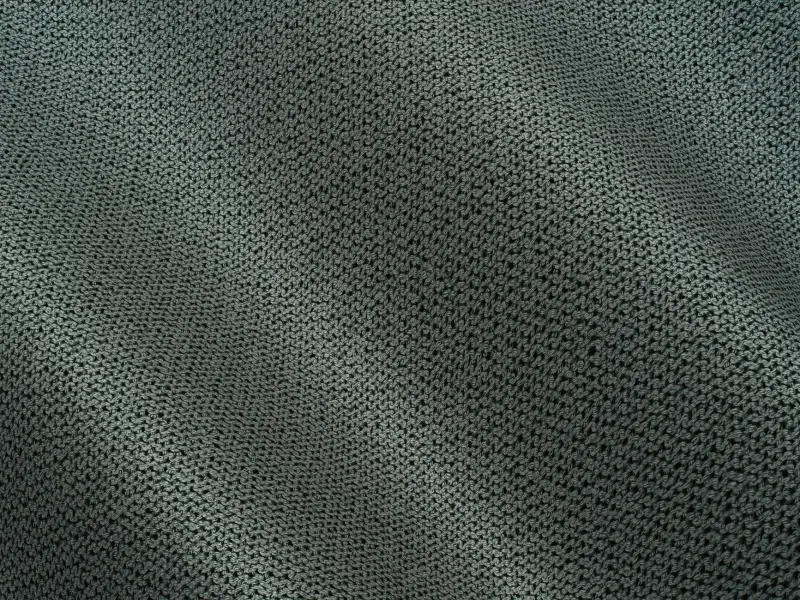
Knitted structures are particularly susceptible to residual shrinkage because the looped architecture of a knit gives yarn considerably more freedom to contract than a woven interlacement does. A single-jersey cotton knit may lose three to five percent of its dimensions in the first wash but continue losing fraction-of-a-percent increments across the next dozen launderings. At the scale of a finished T-shirt, those fractions translate into a garment that fits noticeably differently after a season of regular use.
Loom Tension Memory and Why It Persists
The concept of tension memory deserves more attention than it typically receives in production-level conversations. When a fabric is woven, the warp yarns are maintained under constant, calibrated tension by the loom's beam system. The finished cloth retains a structural bias toward that tensioned state. A single exposure to hot water and agitation allows the yarns to shift toward equilibrium, but the crystalline regions of cellulosic and protein fibers can retain strain for much longer.
This is particularly relevant for fabrics that have been finished with heat calendering or resin treatments, which can temporarily set a fabric in a dimensionally stable state that masks its true relaxed dimensions. A designer who pre-washes such a fabric may observe minimal shrinkage and proceed, only to find that subsequent laundering—once the resin degrades—releases the underlying tension that was chemically suppressed. The finish, not the fiber, was providing the stability, and that stability has a finite lifespan.
Technical Frameworks for Predicting Multi-Cycle Behavior
For designers working on garments expected to undergo repeated laundering—activewear, childrenswear, workwear, everyday apparel—a single pre-wash is an insufficient predictive tool. A more rigorous approach involves multi-cycle testing before committing to a pattern grade.
A practical protocol: wash and dry a measured swatch (minimum 12 by 12 inches, with grain lines marked) three to five times under the care conditions specified for the end use. Measure after each cycle and record the incremental change. If the fabric continues to lose dimension with each cycle, even if the rate of change is slowing, it has not reached dimensional equilibrium and will continue to shift in a finished garment. If the measurements stabilize by cycle three, the fabric has effectively exhausted its relaxation shrinkage and hygral response, and a single pre-wash was sufficient.
This multi-cycle data can also inform pattern grading decisions. If a fabric loses 1.5 percent in length per cycle across three cycles, a designer can calculate total anticipated loss and add compensatory length to pattern pieces before cutting. This is a more precise approach than the common practice of adding a blanket half-inch to hem allowances and hoping for the best.
Compensating at the Pattern and Construction Stage
When multi-cycle testing reveals ongoing dimensional instability, several construction strategies can mitigate the impact on fit.
Longitudinal shrinkage—loss along the lengthwise grain—is generally more consequential for fit than crosswise shrinkage. Adding length to bodice pieces, sleeves, and trouser inseams provides the most practical compensation. For garments with structured seams or interfaced areas, choosing a woven interfacing with a compatible shrinkage rate is essential; a stable interfacing bonded to an unstable shell will create puckering and distortion as the shell continues to contract around it.
For knitwear and jersey constructions, designing with negative ease or incorporating seam allowances that accommodate further reduction can preserve the intended silhouette across multiple washes. In some cases, specifying a pre-shrunk or sanforized fabric at the sourcing stage eliminates the problem at its origin—sanforization mechanically compresses the fabric before finishing, reducing residual relaxation shrinkage to less than one percent.
The Honest Measure of Dimensional Stability
Dimensional stability is not a binary quality a fabric either possesses or lacks. It exists on a continuum, shaped by fiber hydrophilicity, yarn twist, weave or knit structure, finishing treatments, and the mechanical history of the cloth from loom to retail bolt. Pre-washing addresses one layer of that complexity. Understanding the others—and building that understanding into sourcing decisions, testing protocols, and pattern development—is what separates garments that hold their shape across years of wear from those that quietly, incrementally betray the fit they were cut to deliver.