What the Label Doesn't Say: Decoding Blend Percentages to Anticipate Shrinkage, Dye Loss, and Care Demands
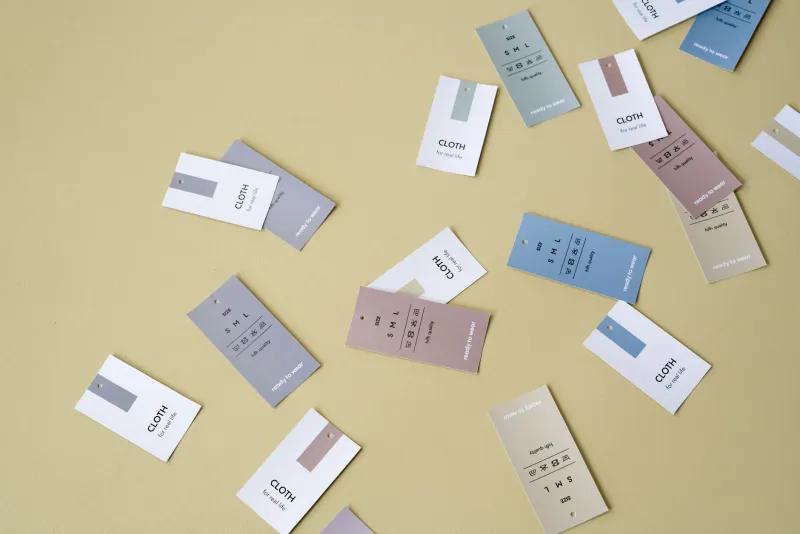
Walk into any fabric showroom and the fiber content tag is usually the last thing anyone examines with care. Buyers run their hands across the surface, hold the cloth to the light, check the drape, and eventually glance at the label—often as an afterthought. Yet that small rectangle of information, when read correctly, functions as a behavioral forecast. The specific percentages, the order in which fibers appear, and the gaps between listed components all carry meaning that fabric specifications rarely make explicit.
For designers working in the US market—where care labeling is regulated by the Federal Trade Commission and where consumers increasingly scrutinize garment longevity—learning to decode blend ratios is not a niche skill. It is a fundamental act of quality control.
How Fiber Order Reflects Dominance, Not Just Composition
Under FTC regulations, fibers listed on a content label must appear in descending order by weight percentage. This means the first fiber named is always the dominant one—and dominant fibers govern most of a fabric's primary characteristics. A label reading "72% polyester, 24% rayon, 4% spandex" tells a very different performance story than one reading "72% rayon, 24% polyester, 4% spandex," even though both contain the same three fibers.
In the first case, polyester's dimensional stability will likely suppress the rayon's natural tendency to shrink and distort in moisture. In the second, rayon's hygroscopic behavior—its tendency to absorb water rapidly and swell along the fiber axis—will dominate, making the fabric significantly more vulnerable to shrinkage, elongation under wet load, and surface texture change after washing.
This ordering principle becomes especially important when evaluating blends that combine natural and synthetic fibers. The synthetic component in a natural-dominant blend often functions as a modifier rather than a stabilizer. At low percentages—say, 10 to 15 percent—polyester or nylon may add modest abrasion resistance without meaningfully reducing the shrinkage potential of the natural fibers around it.
Shrinkage Is Not a Single Number
One of the most persistent misconceptions in textile sourcing is that shrinkage is a fixed, predictable quantity tied to fiber type. In reality, shrinkage in a blended fabric is the product of competing fiber behaviors interacting with yarn structure, fabric construction, and finishing chemistry.
Consider a 55% linen, 45% cotton blend—a combination common in warm-weather suiting and shirting. Both fibers are cellulosic, both absorb water readily, and both shrink in the warp direction under heat and agitation. The blend does not average their shrinkage rates; instead, the two fibers compete for dimensional space during relaxation shrinkage. If the linen yarns were woven under higher tension than the cotton (a common mill practice), the residual tension releases during the first wash and the fabric shrinks more aggressively than either fiber would suggest individually.
Protein-cellulosic blends introduce a different complication. Wool and cotton, for example, shrink by entirely different mechanisms. Cotton undergoes relaxation shrinkage—releasing tension built into the yarn during spinning and weaving. Wool felts: its surface scales interlock under heat and agitation, causing irreversible fiber entanglement. A 60% wool, 40% cotton blend will felt at the wool's threshold, regardless of the cotton's presence. The cotton cannot prevent felting; it can only slightly dilute its severity. Designers specifying such blends for garments intended for machine washing are accepting a meaningful performance risk.
Dye Affinity and the Problem of Two-Fiber Systems
Color behavior in blended fabrics is among the most technically complex—and most underappreciated—aspects of fiber content analysis. Different fiber types accept dye through different chemical mechanisms, which means a single dyebath rarely produces uniform color saturation across a blend.
Polyester is dyed with disperse dyes under high heat and pressure. Cotton requires reactive or vat dyes in an alkaline environment. Wool demands acid dyes at low pH. When these fibers share a fabric, achieving a visually consistent color requires either a two-bath dyeing process—each optimized for one fiber—or a compromise single-bath approach that partially dyes both fibers, typically resulting in lower overall color fastness and a subtly heathered visual effect.
For designers specifying solid-color fabrics in blends, this matters enormously. A 65% polyester, 35% cotton poplin dyed in a single bath will almost always show differential fading after repeated washing: the polyester retains color longer, while the cotton component fades more rapidly, gradually shifting the fabric's appearance toward a two-tone surface. The higher the cotton percentage, the more pronounced this effect becomes over time.
Blends containing more than two fiber types compound the problem. A tri-blend of cotton, polyester, and rayon—popular in the performance-casual market—may require three separate dye applications to achieve even color across all components. Many manufacturers skip this process entirely, accepting the color variance as a design feature or obscuring it through overdyeing. Designers sourcing these fabrics should request wash-fastness data and evaluate it against the garment's intended use cycle.
Reading Care Complexity Before It Becomes a Consumer Complaint
Fiber blend ratios also predict care complexity in ways that garment care labels frequently understate. FTC regulations require only that care labels provide one safe method of cleaning—not the full range of conditions the fabric can or cannot tolerate. This creates a significant information gap for designers responsible for specifying care instructions that are both accurate and practically usable.
A fabric containing any percentage of acetate—even as low as 8 to 10 percent—requires careful temperature management throughout its care life. Acetate is thermoplastic: it softens and deforms under moderate heat, making machine drying at standard temperatures a genuine risk. Yet many blended fabrics containing acetate carry care labels that specify "tumble dry low" without further qualification. The distinction between low and medium heat in a residential dryer is inconsistent enough across appliance brands that "tumble dry low" is not a reliable instruction for acetate-containing garments.
Similarly, fabrics blending silk with any synthetic fiber often carry dry-clean recommendations not because silk alone requires it, but because the synthetic component—typically polyester or nylon—cannot be safely hand-washed with the alkaline detergents most consumers use. The silk could tolerate gentle washing; the blend cannot. Understanding this dynamic allows designers to engineer care instructions that reflect the blend's actual limiting fiber rather than defaulting to the most restrictive option.
The Practical Discipline of Blend Analysis
Building a working knowledge of blend ratio interpretation does not require laboratory access. It requires methodical attention: reading labels with the FTC ordering principle in mind, researching the dye affinity of each listed fiber, and testing wash samples before committing to production yardage.
For designers who work regularly with mill representatives, requesting fiber-specific shrinkage data—warp and weft separately, after one wash and after five—is a reasonable specification practice that most reputable mills can accommodate. For those sourcing from domestic fabric retailers or trade shows, maintaining a personal swatch library with documented wash tests provides the kind of empirical reference that no content label can substitute.
The fiber content label is not marketing. It is a technical document—compressed, regulated, and imperfect, but genuinely informative to those who know how to read it. Treating it as such is among the most straightforward ways to reduce performance failures, improve care instruction accuracy, and make sourcing decisions that hold up through the full life of a garment.