The Thread Behind the Seam: How Fiber Content, Ply, and Twist Determine Whether Your Stitching Holds
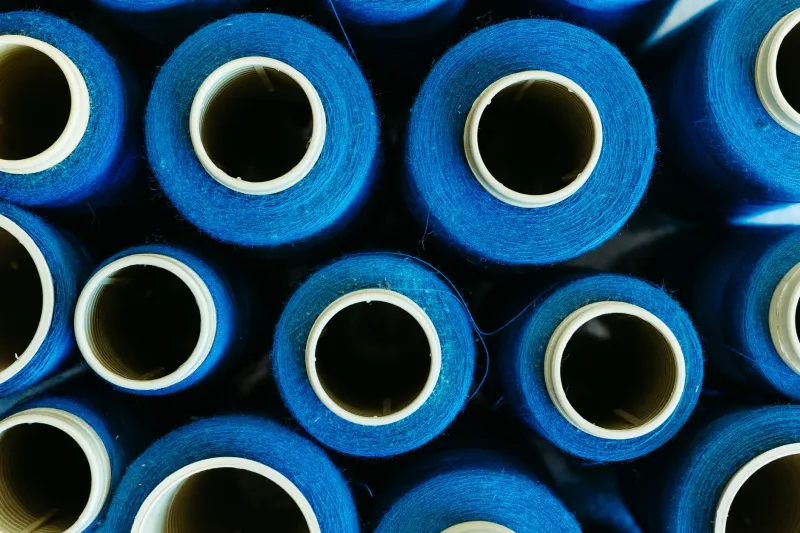
In most professional workrooms, thread selection follows a familiar logic: match the color, pick a weight that seems appropriate, and move on. It is a reasonable shortcut when time is short and the project is forgiving. But for designers working with technical fabrics, delicate silks, or garments expected to perform across years of wear, this approach introduces a variable that quietly undermines everything else the construction process is trying to achieve.
Thread is not a neutral carrier. Its fiber content, how it was spun, how many plies were twisted together, and the direction of that twist all determine how a seam will behave under tension, how it will age alongside the surrounding textile, and whether it will remain invisible or become a structural liability. Treating thread as an afterthought is, in effect, treating the seam as an afterthought.
Why Fiber Content Is the Starting Point
The single most consequential decision in thread specification is fiber composition, because it governs how the thread responds to the same environmental forces acting on the fabric itself.
Polyester thread is the workhorse of industrial and home sewing alike. It resists moisture absorption, holds dye reliably, and offers excellent tensile strength at a low cost. But polyester thread has a stretch coefficient that natural fabrics do not share. When sewn into a seam on woven linen or silk, the thread and fabric respond differently to body movement and laundering stress. Over time, this mismatch creates micro-tension at each stitch point — a condition that can produce subtle puckering, accelerated seam wear, and, in finer fabrics, small perforations at the needle penetration sites.
Cotton thread, by contrast, has virtually no elasticity. It behaves predictably in natural fiber constructions, shares similar moisture response with cotton and linen wovens, and presses flat with heat in a way polyester resists. Its weakness is tensile strength relative to its weight, which makes it less suitable for high-stress applications or garments subject to frequent machine washing at high temperatures.
Silk thread occupies a specialized position. Its natural luster allows it to recede into fine fabrics in a way synthetic threads cannot replicate, and its softness makes it appropriate for hand-sewing on couture-weight materials where a stiffer thread would create unwanted drag. Silk thread is not a luxury indulgence; on the right fabric, it is a technical requirement.
Core-spun polyester threads — which wrap a continuous polyester filament core with a cotton or cotton-blend outer layer — represent a genuine engineering compromise. The core provides strength and controlled stretch; the outer wrap moderates friction through the needle and accepts heat more predictably. For production environments sewing across mixed fabric types, core-spun threads offer a meaningful reduction in seam inconsistency.
Ply Structure and What It Signals About Seam Behavior
Ply refers to the number of individual yarn strands twisted together to form the final thread. A two-ply thread and a three-ply thread of identical weight will perform differently in the seam, and understanding why matters for precision construction.
Higher-ply threads, particularly three-ply constructions, tend to be rounder in cross-section. That roundness allows them to seat more evenly within the stitch structure, which produces a more consistent lock between the top thread and the bobbin thread. In fabrics with an open weave or loose hand — gauze, certain linens, or loosely woven suiting — a rounder thread resists slippage through the weave structure more effectively than a flat or lower-ply alternative.
Two-ply threads are often finer and more suitable for lightweight fabrics, where a heavier thread would create visual bulk at the seam line or generate excessive tension that draws the fabric. However, finer threads carry a lower breaking strength, which must be accounted for when evaluating seam allowance width and stitch density in tandem.
Thread weight notation in the United States often follows a ticket number system, where higher numbers indicate finer threads. A ticket 80 thread is substantially finer than a ticket 40, and selecting the appropriate weight requires understanding not just the fabric's weight in grams per square meter but its weave structure and the intended seam type.
Twist Direction, Tension, and the Machine's Role
Thread twist — the direction in which plies are wound around one another during manufacturing — is perhaps the least discussed technical variable in thread specification, yet it has a direct effect on how thread behaves under sewing machine tension.
Most commercial threads are manufactured with an S-twist, meaning the plies spiral upward to the left when held vertically. Sewing machines are engineered with this twist direction in mind: as the thread passes through the tension discs and needle, the mechanical action of the machine reinforces the twist rather than unraveling it. Using a Z-twist thread in a standard machine will cause the thread to loosen under tension, producing inconsistent stitch formation and increasing the likelihood of skipped stitches or seam weakness.
This is rarely a concern when purchasing thread from established manufacturers, as S-twist is the standard. But when sourcing thread internationally, from specialty suppliers, or when working with hand-spun artisan threads, confirming twist direction before committing to a production run is a worthwhile precaution.
Twist tightness — how firmly the plies are wound — also affects friction behavior through the needle. A tightly twisted thread generates more heat at the needle eye, which is particularly problematic when sewing synthetic fabrics at high machine speeds. In these conditions, thread breakage is often attributed to needle size or machine calibration when the actual cause is the thread's twist structure generating localized heat beyond the fiber's tolerance threshold.
Matching Thread to Fabric: A Practical Framework
The most reliable framework for thread specification begins with the fabric's fiber content and weave structure, then moves to the seam's functional requirements.
For woven natural fibers — cotton, linen, wool — a high-quality mercerized cotton thread or a core-spun thread in an appropriate weight is generally the most technically sound choice. The fiber compatibility reduces differential aging, and both options press and behave predictably under heat.
For silk and fine synthetic wovens, the priority shifts to minimizing needle trauma and thread visibility. Silk thread or a fine polyester filament thread in a weight matched to the fabric's GSM will produce the least seam distortion. Stitch density should increase to compensate for any reduction in individual thread strength.
For stretch fabrics incorporating elastane, thread must accommodate dynamic elongation. A textured polyester thread — also called woolly nylon or textured nylon in trade contexts — has a coiled internal structure that allows it to extend and recover alongside the fabric. Standard spun polyester, despite its strength, will snap under repeated stretch cycles if the stitch type does not also provide mechanical elongation.
For performance and technical textiles, the thread specification should be treated with the same rigor applied to the fabric itself. Seam strength requirements, elongation tolerances, and care cycle expectations should all inform thread selection before a sample is cut.
The Case for Treating Thread as a Specification, Not a Supply
In professional fashion production, every material that enters a garment is ideally specified with precision — fabric weight, finish, construction, fiber content. Thread is rarely granted that same level of attention, yet it is present at every seam, every topstitch line, every bar tack and buttonhole across the entire garment.
The sewist or designer who understands thread as a technical component — rather than a commodity — gains meaningful control over seam quality, garment longevity, and the kind of construction integrity that distinguishes work that holds together from work that merely looks finished at the outset. Thread is not the supporting actor in this process. In many cases, it is the deciding one.